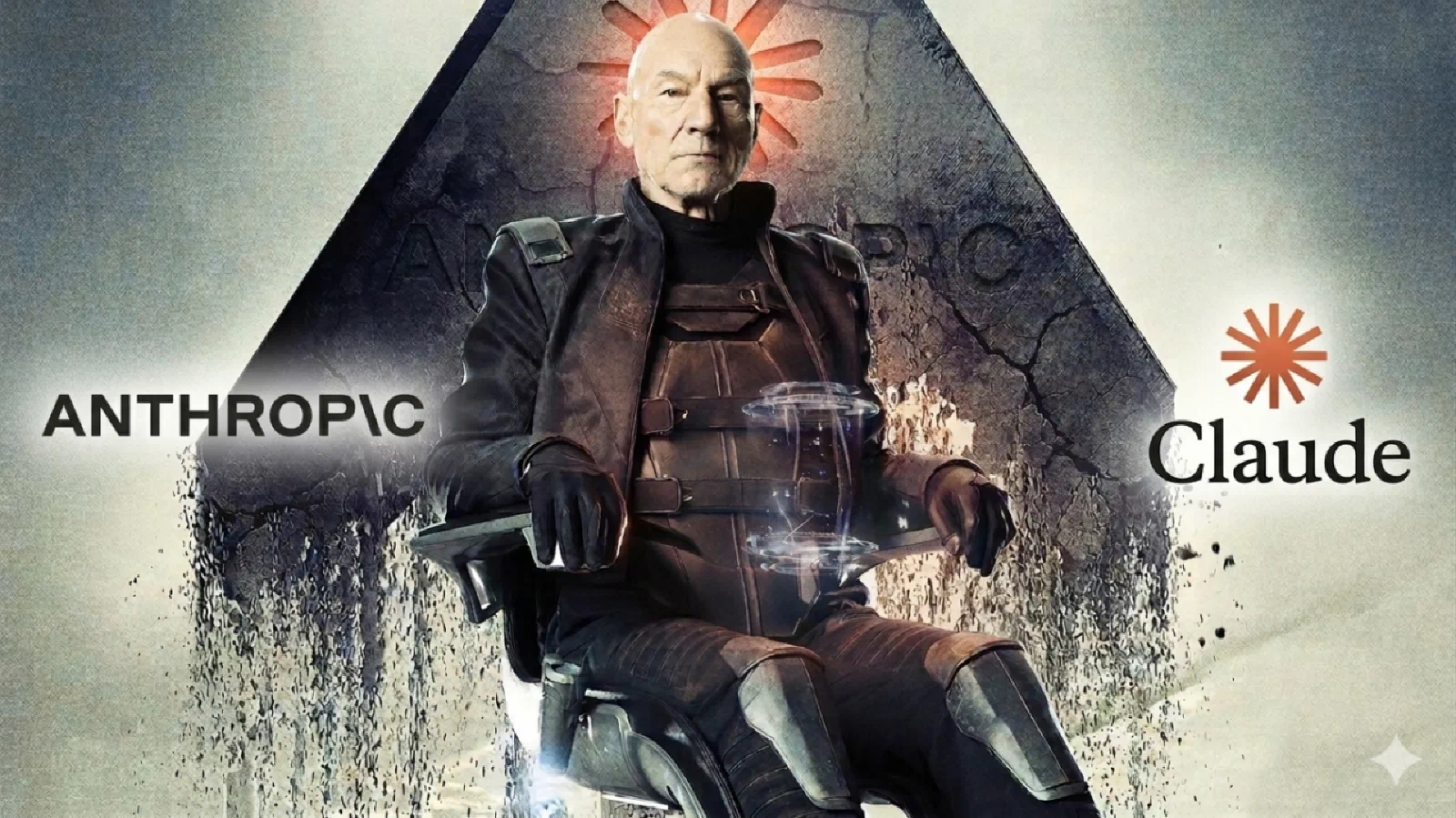
If you’ve ever watched the X-Men, you know Professor Xavier’s power isn’t just reading minds. His real power lies in Cerebro, the machine that amplifies his abilities and lets him find the needle in the haystack in a chaotic world. Without Cerebro, Xavier is just a powerful telepath trying to hear one voice in the middle of a packed stadium. With Cerebro, he has surgical precision.
In the data world, we’re living through the moment when everyone has discovered they have a powerful telepath at their disposal. The promise of LLMs for analytics is seductive: point the model at your data warehouse, let users ask questions in natural language and watch the magic happen. The problem is that, without the right infrastructure, the magic quickly turns into chaos. The model hallucinates, picks the wrong table, uses the old definition of “active user” and delivers an answer that looks right but is fundamentally wrong.
Anthropic, the creator of Claude, solved this problem internally. Today, 95% of the company’s business analytics queries are automated through Claude, with an aggregate accuracy of approximately 98%. Their secret wasn’t building a magic model that never makes mistakes. The secret was building Cerebro: a data and governance architecture that directs Claude’s power with absolute precision.
The Three Enemies of Accuracy
To understand Anthropic’s solution, we need to understand the villains of this story. When an AI agent tries to answer a business question, it doesn’t fail because it can’t write SQL. It fails because the data environment is ambiguous. Anthropic identified three main failure modes that cause the overwhelming majority of errors:
- Entity Ambiguity: The agent can’t map a concept (“revenue for product X”) to the correct table and column because there are dozens of plausible options in the warehouse.
- Staleness: Data sources, business definitions and schemas change constantly. The agent’s knowledge goes stale and it starts returning subtly wrong answers.
- Retrieval Failure: The right information is in the data model and well documented, but the search space is so vast that the agent simply doesn’t find it.
The solution to these problems isn’t prompt engineering. It’s data engineering.
The Foundation: Building the X-Mansion
Anthropic’s first step was to focus on data foundations. If your warehouse has forty tables that seem to contain “revenue,” the agent will get lost. The solution is to create a small, highly governed set of logical models: canonical datasets that are the single source of truth.
That means applying rigorous data engineering practices. Dimensional modeling, shift-left testing and freshness and completeness checks remain essential. The difference is that the end consumer of this data is no longer a senior data scientist who knows how to dodge the warehouse’s traps. The consumer is an AI agent acting on behalf of a business user.
To keep these foundations solid, Anthropic adopted artifact co-location. Almost all data code (modeling, semantic layer, reference documentation) lives in a single repository. If a modeling change breaks a dashboard or invalidates a documented metric, continuous integration (CI) flags the error and the fix ships in the same pull request. It’s like making sure the X-Mansion blueprint is always up to date before any renovation.
Sources of Truth: The Map of Cerebro
If the data foundations are the warehouse, the sources of truth are the reference surfaces the agent consults to navigate it. This is where ambiguity gets destroyed.
The semantic layer is the first line of defense. If a question maps cleanly to a defined metric, the agent calls a function and gets a number: the same number any other dashboard in the company would produce. Anthropic learned the hard way that trying to use an LLM to auto-generate metric definitions from raw tables doesn’t work; the model just encodes the existing ambiguities. Documentation can be AI-generated, but the definition must have a human owner.
When the semantic layer doesn’t cover the question, the agent falls back on data lineage and business context. Business context is often overlooked, but it’s crucial. An agent that doesn’t understand the business will answer what the user asked, but not what they meant. It won’t know that “the Q2 launch” refers to a specific product. Anthropic solves this by feeding the agent a knowledge graph of the company, including indexed documents, roadmaps and the organizational structure.
Skills: Training in the Danger Room
If the sources of truth are the agent’s declarative knowledge, “skills” are its procedural knowledge. They instruct the agent on which sources to consult, in what order, how to navigate ambiguous data and what a finished analysis should look like.
At Anthropic, a skill is a folder of markdown files the agent reads on demand. Without these skills, Claude’s accuracy in answering analytics questions was no more than 21%. With the skills, that number jumped to over 95%.
The main strategy here is to create skills in pairs. A knowledge skill acts as a high-level router. Instead of letting the agent rummage through a warehouse with a million fields, the skill narrows the search space down to a few dozen curated files before a single query is written. It’s like Professor Xavier sending exactly the right team of X-Men on a specific mission, instead of sending every student in the school at once.
These reference documents are written specifically to be read by an LLM. They describe table granularity, known pitfalls (gotchas) and explicit routing triggers (for example: “IF the question is about experiment lift… DO NOT use for raw event counts”).
Validation: The Trial by Fire
The last piece of the puzzle is validation. How do you know whether your agent is actually getting it right?
Anthropic uses offline evaluations (evals) as question-and-answer pairs. They don’t tell you how the online agent will perform, but they ensure there are no critical gaps. The golden rule is to anchor the ground truth so it doesn’t change: an eval written against live data goes stale the moment the underlying number changes. The solution is to pin each eval to a snapshot date, or have the grader judge the agent’s query instead of the final number.
In the online environment, validation continues. Anthropic implemented an adversarial review: a Claude skill that aggressively challenges every underlying assumption in a potential answer. This increased accuracy by 6%, though at the cost of higher latency and token usage. In addition, every answer carries a provenance footer indicating which layer the information came from and how fresh the data is. It doesn’t make the answer more correct, but it helps the consumer judge the level of confidence.
The Mutant Factor
Anthropic’s lesson is clear: accuracy in AI analytics isn’t a code generation problem. It’s a context and verification problem.
Pointing a powerful LLM at a disorganized data warehouse is like putting Professor Xavier in the middle of Times Square without Cerebro. He’ll hear a lot of noise, but he won’t find what you need. The real self-service analytics revolution doesn’t happen when the model gets smarter. It happens when data engineering, governance and business context come together to build the infrastructure that lets that intelligence shine.
The future of analytics isn’t about who has the best model. It’s about who builds the best Cerebro for it.
References:
How Anthropic enables self-service data analytics with Claude | Claude: https://claude.com/blog/how-anthropic-enables-self-service-data-analytics-with-claude