If the ancient Egyptians could build an artificial intelligence, they would probably call on their gods to make the system wiser, faster and more efficient. Just as Ra lit up the world, Thoth recorded knowledge, Anubis judged the truth and Isis brought agility and balance, a well-structured LLM (Large Language Model) needs to combine these elements to work properly.
In practice, building an LLM on Databricks isn’t just about training a language model; it’s about creating a complete solution that can retrieve information in real time (RAG), adapt to context (Fine-Tuning) and run efficiently (MosaicML).
If you want to understand how these technologies can transform your business (and why Databricks is the ideal platform for it), keep reading.
The Traditional LLM: Ra without the Book of Thoth
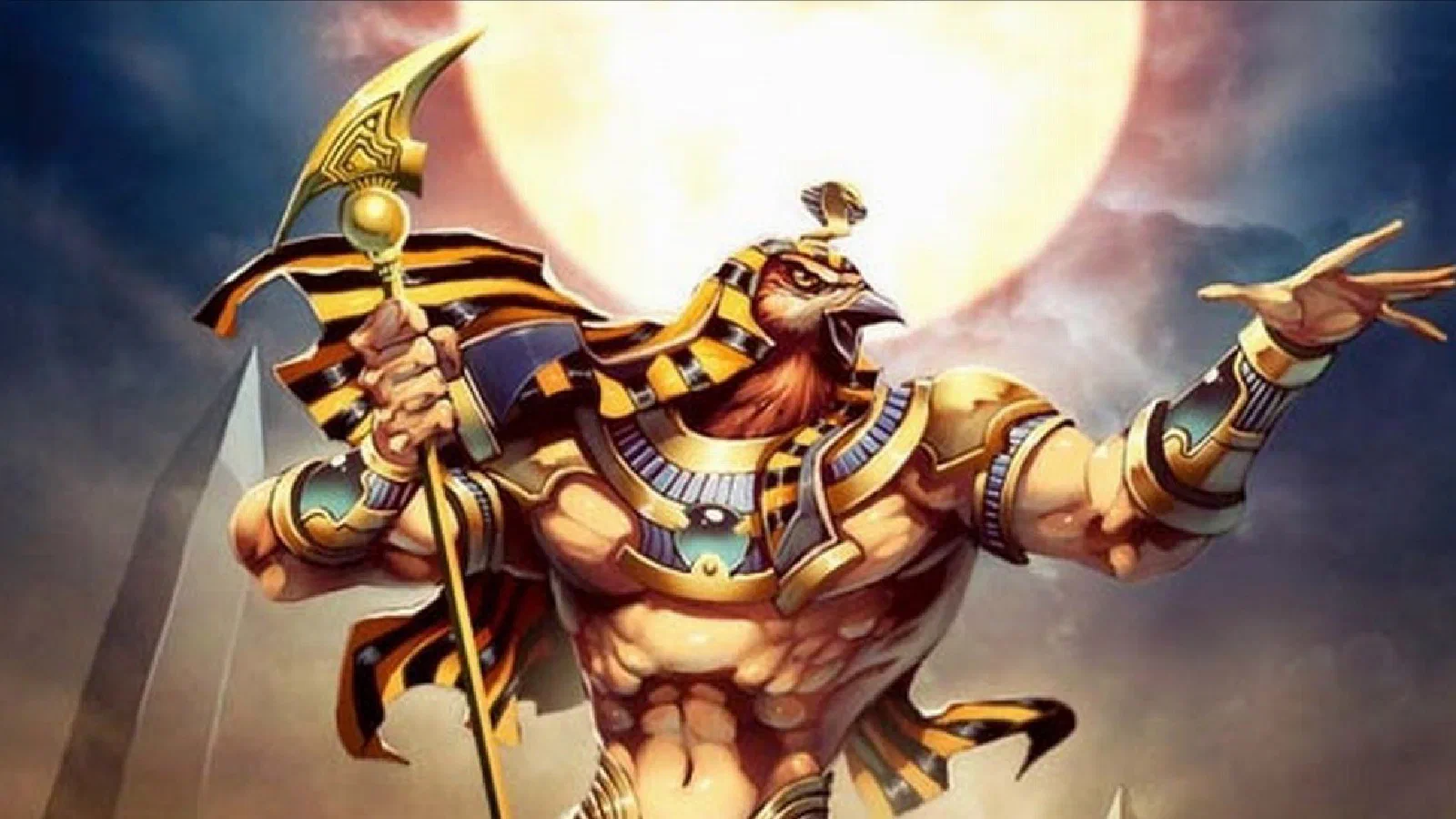
In Egyptian mythology, Ra was the Sun god, responsible for crossing the sky every day in his barque, lighting up the world and bringing knowledge. But even as a powerful god, he had a limitation: he only knew what he saw during his daily journey. If something happened in the underworld or in distant lands, he had no way of knowing.
The same goes for a traditional LLM. It’s trained on a huge amount of data, but once it’s done, it can’t learn anything else on its own. If something new happens in the world (a change in a law, say, or a new product hitting the market), it may give an outdated answer or even make up false data (hallucination).
In a business context, that means a chatbot that answers questions incorrectly, a contract analysis system that ignores recent clauses, or a virtual assistant that can’t explain the company’s new policy.
To solve this problem, we need something that lets the LLM fetch up-to-date information before answering. And that “something” has a name: RAG.
LLM with RAG: Thoth and the Book of Wisdom
In Egyptian mythology, Thoth was the god of wisdom, writing and accounting. He was responsible for recording everything that happened and owned the Book of Thoth, which held all the knowledge in the universe.
If Ra could consult this book before answering questions, he wouldn’t depend on his own memory alone; he could access external information to provide accurate, up-to-date answers.
That’s exactly what RAG (Retrieval-Augmented Generation) does.
With RAG, the LLM can access databases, internal documents, APIs and Data Lakes to complement its answer. It doesn’t depend only on what it learned during training; it can fetch new data in real time.
💡 Practical example: Imagine a bank wants to use a chatbot to answer customer questions about investments. If the interest rate changes today, a traditional LLM may keep giving the old answer. But with RAG, it looks up the correct information before answering, making sure the customer gets up-to-date, reliable data.
How do you implement RAG in Databricks?
Databricks is ideal for this approach because it:
- Lets you store documents and structured tables in a Delta Lake.
- Makes it easy to build vector databases using libraries such as ChromaDB.
- Offers scalable APIs for data retrieval.
In Databricks, we can set up a RAG pipeline like this:
from langchain.document_loaders import CSVLoader
from langchain.vectorstores import Chroma
from langchain.embeddings import HuggingFaceEmbeddings

# Carregar documentos empresariais
loader = CSVLoader("dbfs:/mnt/datalake/documentos.csv")
documents = loader.load()

# Criar embeddings para busca eficiente
embeddings = HuggingFaceEmbeddings(model_name="sentence-transformers/all-MiniLM-L6-v2")
vectorstore = Chroma.from_documents(documents, embeddings)

# Criar um retriever para buscar informações relevantes
retriever = vectorstore.as_retriever()
Now the LLM can consult the “Book of Thoth” whenever it needs to, ensuring smarter, more reliable answers.
Fine-Tuning: The Judgment of Anubis and Osiris
The ancient Egyptians believed that, upon death, the soul went through the Judgment of Osiris. Anubis, the god of the dead, weighed the heart of the deceased against the feather of the goddess Maat, symbol of truth and justice. If the heart was light, the soul could move on to eternal life. If it was heavy, it would be devoured by Ammit, the devourer of souls.
Fine-Tuning plays this role for an LLM. It tunes the model so its answers are evaluated and refined until they reach an acceptable level of accuracy.
In Databricks, this can be done with clusters optimized for deep learning, speeding up the process of tuning the model to meet the specific needs of the business.
from transformers import AutoModelForCausalLM, TrainingArguments, Trainer

model_name = "mistralai/Mistral-7B"
model = AutoModelForCausalLM.from_pretrained(model_name)

training_args = TrainingArguments(
    output_dir="./results",
    per_device_train_batch_size=2,
    num_train_epochs=1
)

trainer = Trainer(
    model=model,
    args=training_args,
    train_dataset=meus_dados_treinamento
)

trainer.train()
Now the model has passed the judgment of Anubis and Osiris and is ready to provide reliable answers.
MosaicML: The Wings of Isis for Productization
Just having a trained model isn’t enough. It has to be fast and efficient. MosaicML is like the wings of Isis, letting the LLM run without consuming absurd amounts of computing power.
With MosaicML on Databricks, we can:
- Cut inference costs with optimizations such as quantization and pruning.
- Speed up response time without compromising quality.
- Scale the model to thousands of users without freezing up.
In Databricks, the optimized model can be saved and deployed with MLflow:
import mlflow

mlflow.set_experiment("/Users/seu_usuario/RAG_experiment")

with mlflow.start_run():
    mlflow.transformers.log_model(model, artifact_path="llm_produtizado")
Now we have an LLM that not only answers well, but does it with speed and efficiency.
Creating a God of Artificial Intelligence
Throughout Egyptian mythology, the gods didn’t act alone. Each one had an essential role in keeping the world running in balance. To create a truly efficient LLM, we need to combine these divine forces: the light of knowledge, access to infinite wisdom, careful evaluation of answers and the speed to operate effectively.
Just as Egyptian priests combined different deities to solve the challenges of the ancient world, we bring together RAG, Fine-Tuning and MosaicML to build a robust, reliable and agile model. Below is the full analogy:
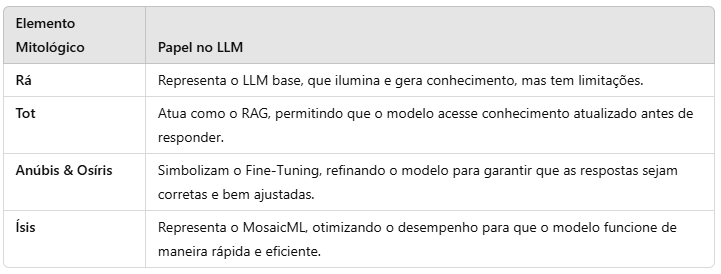
_Comparison of mythological elements_
Conclusion
Building an LLM on Databricks with RAG, Fine-Tuning and MosaicML isn’t just a technical challenge; it’s a way to take artificial intelligence to a new level of usefulness and efficiency.
Imagine the impact of a system that doesn’t just answer questions, but looks up the right information, learns from the company and runs in an optimized way. This kind of solution can transform companies by cutting operating costs, improving the user experience and increasing the reliability of the information provided.
If in Ancient Egypt knowledge was passed down through papyri and temples, today we have tools like Databricks and MosaicML to process billions of data points in seconds. The principle, however, remains the same: knowledge must be accurate, reliable and efficient.
And so, by combining these technologies, we create a true god of artificial intelligence, able to bring light, wisdom, justice and speed to the age of AI.