
For years, the data world chased the dream of a “single source of truth”. In practice, however, what many companies built was a real Tower of Babel. Every department, every team, every analyst created their own dialect, their own definitions for essential metrics. The result? Conflicting reports, decisions based on diverging numbers and widespread distrust of the data. Ten sales reports showed ten different numbers for “net revenue”, and nobody knew which one was right.
Microsoft Fabric IQ, one of the most impactful announcements at Ignite 2025, isn’t just another tool in this landscape; it’s the architectural solution for tearing down that Tower of Babel. It was designed to fix the root cause of the problem: the lack of a central, governed dictionary for the language of the business. Fabric IQ proposes a paradigm shift: instead of replicating business logic in every report and model, let’s define it once, in a single place, and have the whole ecosystem, from BI reports to AI agents, drink from that same source.
In this article, we’ll take a deep dive into what Fabric IQ is, breaking down its components, explaining how it works technically and, most importantly, the transformative impact it brings to data architecture and to the way companies will make decisions in the future. It’s the end of the era of ambiguity and the beginning of the era of semantic clarity.
What Exactly Is Fabric IQ?
If the corporate Tower of Babel was built on the lack of a common language, Fabric IQ arrives to be the universal dictionary and official translator of this new era. Imagine that each department (Sales, Marketing, Finance) spoke a different dialect, making communication impossible. Fabric IQ doesn’t just create a single, official language for the whole company; it also makes sure everyone speaks it fluently, eliminating confusion and ambiguity once and for all.
Technically, Fabric IQ is the semantic intelligence layer of Microsoft Fabric. It centralizes business logic in a new first-class Fabric item called Ontology. An ontology is, essentially, a formal model of your business. It’s where you define what the important “things” are (entities such as Customer, Product, Sale), how they relate to one another (a Customer makes a Sale, a Sale contains a Product) and which rules and hierarchies govern them.
The power of Fabric IQ comes from its five integrated components, which work together to bring this ontology to life:
- Ontology: The “master plan” or the “DNA” of the business. It defines the entities, relationships and rules.
- Semantic Model: The analytics layer on top of the master plan. It adds the metrics, KPIs and calculations (DAX) that will be used in reports.
- Graph: The system of connections. It enables complex queries that traverse the relationships defined in the ontology.
- Data Agent: The intelligent “translator”. It uses the ontology to understand natural language questions and find answers in the data.
- Operations Agent: The autonomous “guardian”. It monitors data in real time and takes action based on the rules defined in the ontology.
The Anatomy of Fabric IQ: Diving into the 5 Components
To understand the impact of Fabric IQ, you need to understand how each of its parts works.
1. Ontology: The Foundation of Everything
The Ontology is the heart of Fabric IQ. This is where the magic begins. Instead of modeling data in tables and columns, you start modeling the business in entities and relationships. The big advantage is that this can be done in a low-code way, letting business users collaborate with the technical team to create a model that truly reflects the company’s reality. A key capability is the automatic generation of ontologies from existing Power BI semantic models, which means you can reuse work that’s already been done and speed up adoption.
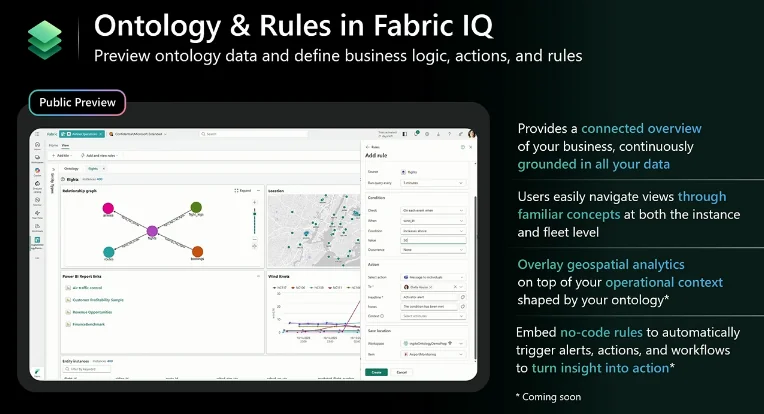
_Fabric IQ Ontology_
2. Semantic Model: The BI Lens on the Business
If the Ontology is the treasure map, the Semantic Model is the set of tools you use to read it. This is where traditional BI logic, such as complex DAX measures, KPIs and analysis perspectives, gets added on top of the ontology. The crucial difference is that this logic is built on a consistent, governed business model rather than on loose tables. That ensures that when you create a “Sales Growth” KPI, the definition of “Sale” is the same for everyone.
3. Graph: The Power of Connections
Fabric IQ doesn’t just store the entities; it deeply understands how they connect. The Graph component is a native graph engine that lets you ask questions that would be extremely complex in a traditional relational model. For example, you can easily traverse multiple relationships to answer a question like: “Show me every customer who bought product X, who had a delivery problem reported by sensor Y in the cold chain, and who opened a support ticket in the last 24 hours.” The graph makes cross-domain reasoning a native capability.
4. Data Agent: The Virtual Analyst
Data Agents are the face of Fabric IQ for the end user. They’re AI agents you can query in natural language. Because they’re “built” on top of the Ontology, they’re born with a deep understanding of your business. When a user asks “Who were my most profitable customers in Brazil last quarter?”, the agent knows what a “customer” is, what “profitable” means, how to filter by “Brazil” and how to interpret “last quarter”, because all of those definitions and hierarchies live in the ontology. It’s the democratization of access to insights, with no need to know SQL or DAX.
5. Operations Agent: Intelligence in Action
While Data Agents answer questions, Operations Agents act. They’re autonomous agents that monitor data in real time and take action based on the rules defined in the ontology. For example, a rule in the ontology might say: “If the temperature of a vaccine container (entity) exceeds 5°C (rule), fire an alert (action) to the responsible logistics manager (relationship).” Operations Agents turn business knowledge into intelligent automation, 24 hours a day, 7 days a week.
The Architectural Impact: Why Fabric IQ Changes the Game
For those who design and build data systems, Fabric IQ represents a fundamental shift. The main impact is the definitive consolidation of the semantic layer. This solves a series of chronic architectural problems:
- The End of Redundancy: Business logic is defined only once. You no longer need to copy and paste the same DAX formula into 20 different Power BI models. Maintenance becomes trivial: update the rule in the ontology, and every report and agent that consumes it is updated automatically.
- Centralized Governance: The Ontology becomes the central point of governance. It’s where data lineage converges with semantics, letting you track not only where the data came from but what it means at each step. Security and access policies are applied in the ontology itself, ensuring consistency.
- Reuse and Agility: Once the business ontology is built, it becomes a reusable asset for any new project. A new product team doesn’t need to “rediscover” what a customer is; it simply consumes the “Customer” entity from the ontology. This drastically speeds up the development of new data and AI solutions.
- Unifying BI and AI: Fabric IQ knocks down the wall that traditionally stood between the world of Business Intelligence and the world of Artificial Intelligence. The same semantic layer that feeds a Power BI dashboard is used to “teach” an AI agent about the business. That ensures BI insights and AI answers are always consistent.
How to Implement Fabric IQ in Practice: A Starter Guide
Knowing what Fabric IQ does is one thing; implementing it is another. The approach shouldn’t be a “big bang”, but an iterative, strategic process. Here’s a step-by-step guide to get started:
- Start Small, Think Big: Don’t try to model the entire company at once. Pick a critical, well-understood business domain, such as “Sales” or “Customers”. The goal is to create value quickly and use that first project as a success story to expand from.
- Reuse What Already Exists: The ability to generate an ontology from existing Power BI semantic models is your best starting point. Identify the most complete and trusted Power BI model in the chosen domain and use it to create the first version of your ontology. This saves time and leverages the knowledge already built into your reports.
- Involve the Business (for Real): The ontology is a business model, not just a technical artifact. Use the low-code interface to sit down with the domain experts (business analysts, product managers) and refine the entities, relationships and rules. Ask questions like: “What defines an ‘active customer’ for you?” or “What are the life stages of an ‘order’?” This collaboration is crucial to success.
- Connect the Data: Once the ontology is defined, the next step is to bind the real data in OneLake to it. Map the tables and columns of your lakehouse to the ontology’s entities and properties. This is where raw data gains business meaning.
- Build on Top: With the ontology populated, start building. Create a new Semantic Model on top of it for your BI reports. Set up a Data Agent so users can ask questions in natural language. Create an Operations Agent to automate a simple process. What matters is demonstrating the value of the unified semantic layer across different experiences.
Strategies for Migrating Your Semantic Models
Migrating dozens or hundreds of Power BI models to a centralized ontology may sound daunting, but with the right strategy it becomes a process of adding value rather than a costly refactoring.
Approach 1: The “Golden Model” Strategy
In this approach, you identify the organization’s most comprehensive and trusted semantic model, the “Golden Model”. This model becomes the foundation for your main ontology. The migration happens in phases:
- Extraction: Use the “Golden Model” to generate the initial ontology in Fabric IQ.
- Consolidation: Analyze other semantic models that are subsets or variations of the “Golden Model”. Instead of migrating them, retire them and switch to the new centralized Semantic Model built on the ontology. Use Power BI perspectives to provide tailored views for different user groups, if needed.
- Expansion: For models that contain business logic that wasn’t in the “Golden Model”, enrich the central ontology with those new entities, relationships or rules. The goal is to let the ontology grow organically.
Approach 2: The Domain-Federated Strategy
For very large, decentralized organizations, a single ontology may be impractical at first. The federated strategy proposes creating multiple ontologies, one for each major business domain (Finance, HR, Marketing, etc.).
- Domain Mapping: Identify the company’s main data domains and the semantic models associated with each one.
- One Ontology per Domain: Create a separate ontology for each domain, following the “Golden Model” approach within each one. This lets domain teams work autonomously.
- Cross-Domain Connection: The crucial step is creating relationships between the domain ontologies. For example, the “Customer” entity in the Marketing ontology can be linked to the “Customer” entity in the Finance ontology. Fabric IQ was designed to support this kind of federation, giving you local governance with global connectivity.
Whatever the approach, the principle is the same: stop replicating, start reusing. Migrating to Fabric IQ isn’t about moving PBIX files from one place to another; it’s about extracting the valuable business logic that lives inside them and lifting it into a shared, governed, reusable intelligence layer for the whole organization.
Conclusion: From Data to Real Intelligence
Fabric IQ is much more than a new feature; it’s the missing piece in the puzzle of the data-driven company. It attacks the root of the semantic inconsistency problem, providing a solid foundation on which we can confidently build analytics, AI agents and automated processes.
By creating a central, living “dictionary” for the business, Fabric IQ turns OneLake from a simple data repository into a true digital brain for the organization. It’s the technology that finally lets us stop arguing about what the data means and start acting on the unified knowledge it provides.