In 1977, when the movie theater lights went down and that iconic opening crawl started scrolling across the screen, nobody knew exactly what was about to happen. Star Wars wasn’t just a movie; it was a rupture, a redefinition of what was possible. Microsoft Microsoft Build 2026 had that same flavor. With the theme “Be Yourself at Work”, Microsoft didn’t just present a set of new products. It presented a new galactic order for software development and for artificial intelligence in the enterprise.
For decades, the relationship between organizations and technology was one of dependence. Dependence on platforms, on third-party models, on consultancies that held the knowledge. Build 2026 marks the turning point: Microsoft is betting that the competitive edge of the future is no longer access to artificial intelligence, but ownership of it. It’s not enough to have access to the Force; the Force has to be yours, shaped by your history, your data and your rules.
In this article, we’ll walk through the three big pillars of Build 2026 with the depth each one deserves: the new Microsoft IQ context layer, the MAI family of in-house models and the governance framework that makes sure all of this runs securely in production. Get your lightsaber ready.
Episode I: The Phantom Menace of Generic Context
Before understanding what Microsoft announced, you need to understand the problem it’s solving. Over the last two years, the race for AI in the enterprise produced a predictable pattern: technology teams deploy powerful language models, connect a few data sources and expect transformative results. What usually happens is quite different.
Agents respond generically because they don’t understand the organization’s real context. They know what an email is, but they don’t know that this particular email is tied to a critical project that’s running late. They know what a meeting is, but they don’t understand that this meeting involves a client who’s about to cancel the contract. The intelligence is there, but the context is missing.
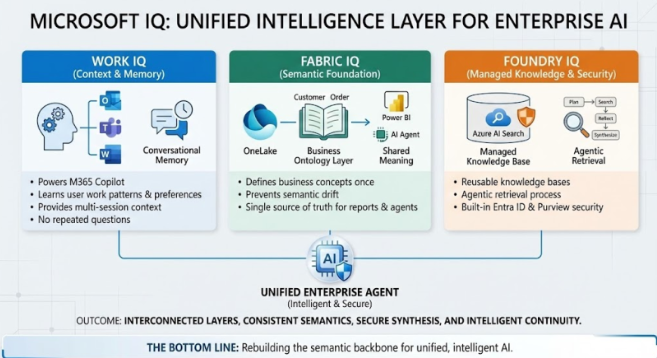
That’s exactly the gap Microsoft IQ was designed to fill. Available starting today in GitHub Copilot, Microsoft Foundry and Copilot Studio, Microsoft IQ is described as a new context layer that grounds agents in both world knowledge and your company’s specific knowledge. It’s not a standalone product; it’s an intelligence infrastructure made up of four specialized layers that work together.
_https://jannikreinhard.com/2025/11/26/microsoft-iq-the-intelligence-layer-that-finally-makes-ai-agents-useful/_
Work IQ: The Intelligence of the Workflow
Work IQ is the layer closest to people’s day-to-day. It captures how work really happens in Microsoft 365, understanding the connections between people, emails, documents, meetings and how it all fits together. It’s not just a document index; it’s a living representation of how the organization works.
Think of Work IQ as your organization’s Master Yoda. It doesn’t just know the facts; it understands the relationships, the tensions, the unspoken priorities. When an agent powered by Work IQ gets a question about a project’s status, it doesn’t just look for documents with that name. It understands who the key people are, what the latest decisions were, where the blockers are and what needs to happen next.
The Work IQ APIs become generally available on June 16, 2026, letting developers access this intelligence layer programmatically. That means any agent, built in any framework, can be enriched with the real context of the organization’s workflow.
Fabric IQ: The Language of Business Data
If Work IQ takes care of the human and relational context, Fabric IQ takes care of the context of structured business data. It provides a shared semantic foundation over the data that lives in Microsoft Fabric, making sure that when an agent talks about “revenue”, “margin” or “churn”, it’s using the same definitions as the finance team, the sales team and the product team.
This problem of inconsistent semantics is more serious than it looks. In large organizations, it’s common for different areas to use the same terms with different definitions. Fabric IQ acts as the C-3PO of the data galaxy: fluent in over six million forms of communication, making sure every agent speaks the same language when it comes to the business’s critical data.
Foundry IQ and Web IQ: Connecting the Universe
Foundry IQ is the link that ties the other layers together, enabling retrieval planning across both enterprise knowledge and the real-time web. It’s the intelligence that decides, when faced with a complex question, which sources to consult, in what order and how to combine the answers.
The newest member of the family is Web IQ, announced at the event itself. It’s described as the fastest way to ground agents in real-world information: an AI-first, model-agnostic, MCP-native (Model Context Protocol) web search stack, able to return relevant passages almost 2.5 times faster than the best alternative available on the market. For agents that need up-to-date information on markets, regulations or external events, Web IQ is the hyperdrive that takes them where they need to go in record time.
Episode II: The Empire of In-House Models
For a long time, the big tech companies depended on third-party models to power their AI products. Microsoft is no exception: Copilot was built on OpenAI’s models, and that partnership remains important. But Build 2026 marked an inflection point: Microsoft is building its own AI models, and they’re competitive.
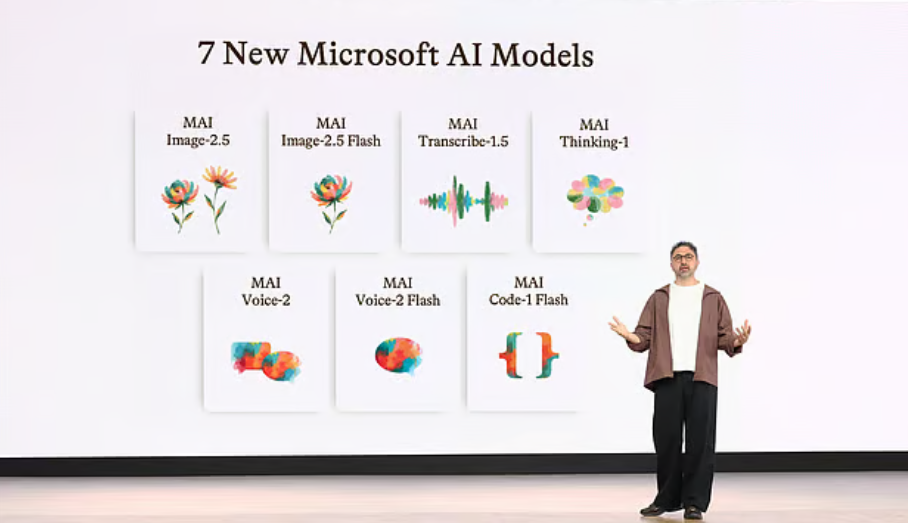
The MAI (Microsoft AI) family was introduced with seven new in-house models, each designed for a specific purpose. This specialization strategy is like assembling an imperial fleet: each ship has a defined role, and together they cover the full spectrum of needs.
_Credits: X/@mustafasuleyman_
MAI-Thinking-1: The Star Destroyer of Reasoning
The family’s flagship is MAI-Thinking-1, Microsoft’s first reasoning model. What makes it especially relevant isn’t just its performance, but how it was built: trained from scratch, with no distillation from other models, on clean, commercially licensed data. For companies worried about intellectual property and compliance, that’s a significant differentiator.
With 35 billion active parameters and a 256K-token context window, MAI-Thinking-1 was designed specifically to handle complex multi-step instructions, long-context reasoning and code generation. The benchmark numbers are impressive: in blind tests, independent evaluators preferred MAI-Thinking-1 over Sonnet 4.6, and it matched Opus 4.6 in coding skills on SWE Bench Pro. For a first reasoning model, these are results that immediately put Microsoft among the serious contenders in this category.
The model is available in Foundry in private preview starting today.
MAI-Image-2.5: The Visual Craftsman
MAI-Image-2.5 represents Microsoft’s entry into the image generation and editing model market, and it came in strong. It’s Microsoft’s first model to support both text-to-image and image-to-image workloads. On the Arena AI leaderboard, it ranks third in text-to-image and second in image-to-image, ahead of established competitors.
What makes this model particularly interesting for the Microsoft ecosystem is its native integration. It’s already live in PowerPoint, rolling out in OneDrive and coming to Foundry with market-leading quality per dollar. For marketing, design and communications teams that already live in the Microsoft 365 ecosystem, that represents significant creative capability without leaving the work environment.
The Full Family: Specialists for Every Mission
Besides the two main models, the MAI family includes:
MAI-Transcribe-1.5 combines state-of-the-art accuracy across 43 languages, with streaming coming soon. For global organizations operating in multiple countries, the ability to transcribe meetings, calls and audio content with high accuracy in dozens of languages is a critical operational capability.
MAI-Voice-2 and its flash variant are now available in more than 15 new languages with new voice options. Combined with MAI-Transcribe-1.5, this creates a complete voice infrastructure that can power everything from call center assistants to voice interfaces for industrial applications.
MAI-Code-1 is an inference-efficient coding model, tuned specifically for GitHub and now available in Copilot and VS Code. Its code specialization, combined with inference efficiency, makes it ideal for scenarios where speed and cost are critical, such as real-time suggestions while typing.
Openness and Choice: Beyond the In-House Catalog
Microsoft made it clear that the strategy isn’t to build a walled garden. The MAI models will be available on third-party platforms such as Fireworks AI, Baseten and Open Router. At the same time, Fireworks AI becomes generally available in Foundry, offering a single platform experience with enterprise governance and data residency in Azure, regardless of the model chosen.
This openness is strategic. Microsoft is betting that by offering the best platform to run any model, it becomes indispensable even for customers who prefer models from other vendors.
Episode III: The Return of Governance
With great power comes great responsibility, and the proliferation of autonomous agents in enterprise environments raises serious questions of security, compliance and governance. Who’s accountable when an agent makes a wrong decision? How do you make sure agents don’t access data they shouldn’t? How do you audit what an agent did?
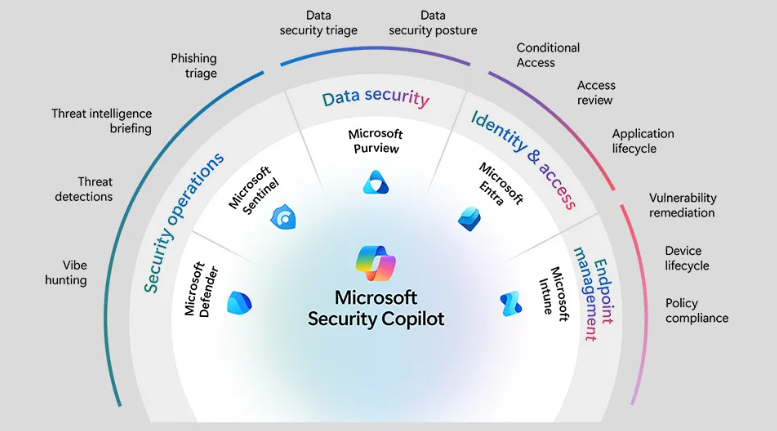
Microsoft presented a comprehensive answer to these questions, building what could be described as the Galactic Republic of agent governance.
_https://www.microsoft.com/pt-br/microsoft-agent-365_
Agent 365: The Galactic Senate of Agents
Agent 365 for local agents is the centerpiece of this framework. It extends Entra, Defender and Purview into a single control plane to observe, govern and protect agents across the entire enterprise environment, regardless of where they’re hosted or which framework they were built in.
That last point is crucial. Agent 365 isn’t just for Microsoft agents. It works as a universal control plane, able to monitor and govern agents built in LangChain, AutoGen, CrewAI or any other framework. For CISOs and security teams watching AI agents proliferate across their organizations, that centralized visibility is fundamental.
Frontier Tuning: Training Your Own Jedi Knights
One of the most strategic announcements at Build 2026 is Frontier Tuning, available in private preview starting today. It applies reinforcement learning within the organization’s compliance perimeter, letting agents learn how the business really works.
Using the organization’s own data, domain knowledge and workflows, Frontier Tuning creates a loop that improves as the agents work. It’s the difference between hiring an outside consultant who knows market best practices and training an in-house employee who knows the specifics of your business. Over time, an agent trained with Frontier Tuning doesn’t just follow generic rules; it internalizes the way your organization thinks and operates.
ASSERT and Agent Control Specification: The Galactic Constitution
To make sure governance is consistent and auditable, Microsoft announced two open source projects that form the foundation of agent security.
ASSERT (Adaptive Spec-driven Scoring for Evaluation and Regression Testing) is a framework for policy-based safety evaluation. It lets organizations define expected-behavior policies for their agents and continuously validate whether those agents are operating within them. It’s like having an automated audit system that constantly checks whether the agents are following the Galactic Constitution.
The Agent Control Specification standardizes where and how to apply controls in the agent loop. By creating an open standard for this, Microsoft is trying to establish a common language for agent governance that can be adopted across the whole ecosystem, regardless of framework or platform.
Codename MDASH: The Proactive Defense Fleet
Rounding out the security layer, Codename MDASH represents a radically different approach to software security. Instead of waiting for vulnerabilities to be discovered and reported, MDASH deploys more than 100 specialized agents to proactively find exploitable bugs.
These agents reason about data flow, business logic and exploit chains, delivering context-aware fixes directly in the Defender Portal. It’s like having a fleet of X-Wing fighters constantly patrolling the perimeter, spotting threats before they become crises.
What This Means in Practice
Microsoft Build 2026 wasn’t an event of isolated announcements. It was the presentation of a coherent, integrated vision of how Microsoft believes AI will evolve in the enterprise. That vision has three characteristics that set it apart from what had been done so far.
First, the emphasis on owning the intelligence. The event’s central message was clear: the competitive edge is no longer having access to the most powerful AI. It’s having an AI that is genuinely yours, fed by your data, trained on your processes and operating within your rules. Microsoft IQ, Frontier Tuning and the MAI family are all pieces of that strategy.
Second, the bet on openness as a competitive advantage. By making the MAI models available on third-party platforms, by building Agent 365 to govern agents from any framework and by launching open source projects like ASSERT and the Agent Control Specification, Microsoft is signaling that its advantage lies not in lock-in, but in the quality of the platform.
Third, its seriousness about governance and security. At a time when many companies are still figuring out how to use AI agents responsibly, Microsoft arrived at Build 2026 with concrete answers to the hardest questions: how to audit, how to control, how to ensure compliance and how to protect sensitive data.
The galaxy of enterprise AI is changing fast. Build 2026 made it clear that Microsoft isn’t just taking part in that change; it’s trying to define it. May the Force be with you.
References:
[1] Microsoft Build 2026: Be yourself at work - The Official Microsoft Blog: https://blogs.microsoft.com/blog/2026/06/02/microsoft-build-2026-be-yourself-at-work/
Agent 365: https://www.microsoft.com/pt-br/microsoft-agent-365