
In the world of technology, few tasks are as critical and delicate as data migration. Whether to modernize systems, adopt the cloud or consolidate platforms, moving data from one place to another is a journey that demands planning, precision and a well-defined strategy. How that move is carried out can determine a project’s success, with a direct impact on business continuity.
Imagine you’re moving house. Your data is all your furniture, appliances and belongings accumulated over the years. The old system is the house you live in now, and the new system is that modern, spacious house you’re moving into. The big question is: how do you make the move? Do you pack everything at once and face one chaotic weekend to get it over with quickly? Or do you take things over little by little, keeping the old house running until the new one is completely ready?
In this article, we’ll explore the three main approaches to this moving journey: Big Bang, Trickle and Hybrid. We’ll use the house-moving metaphor to demystify each concept and help you choose the right path for your scenario.
The Migration Strategies in Detail
Each migration approach has distinct characteristics, advantages and disadvantages. The ideal choice depends on the complexity of the environment, the tolerance for downtime and the business goals. Let’s see how each one works in the context of our move.
Big Bang Migration: The Weekend Move
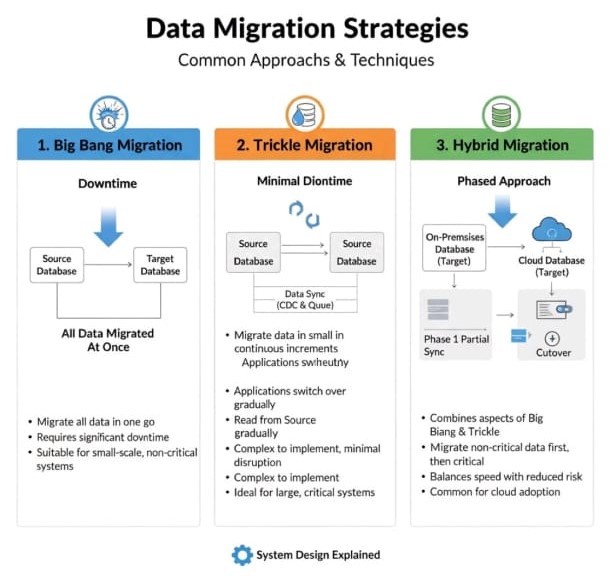
The Big Bang approach is like deciding to do the whole move in a single weekend. You hire the truck, round up your friends, pack absolutely everything and move all your belongings in one go. During this process, your old house is completely unlivable. The furniture has been taken apart, the boxes are stacked up, and you can’t even make a cup of coffee. It’s a significant period of downtime, but when it’s over, the move is done.
In the data context, every record is transferred from the source system to the target system in a single operation. The old system is shut down, and after the migration only the new system is operational. Simplicity is its greatest advantage: there’s no need for complex synchronization or for keeping two environments running at the same time.
This strategy is best suited to small-scale or non-critical systems, where a scheduled downtime window is acceptable. It’s like moving out of a small apartment where you can get everything organized in a few hours. But for operations that can’t stop, this approach becomes unworkable. After all, you can’t leave your business unlivable for long.
Big Bang Pros and Cons
Advantages:
- Simpler planning: With just one migration event, the planning process can be more straightforward than with phased approaches.
- Lower long-term costs: Since the old and new systems don’t run in parallel for an extended period, there are savings on maintenance and support.
- Immediate full functionality: After the migration, the new system is fully operational, delivering every feature without a period of limited or partial capacity.
- Clear transition: It provides a clear, definitive cutover point, which can be easier for some organizations to manage and communicate internally.
Disadvantages:
- High risk: If something goes wrong during the migration, it can have immediate, widespread effects across the entire organization.
- Hard to test and troubleshoot: Full testing is challenging when everything changes at once, and post-migration troubleshooting can be more complex.
- Potentially disruptive: The sudden change can disrupt business operations and may require significant downtime during the transition.
- User adaptation challenges: Users must adapt to the new system all at once, which can lead to resistance or a steep learning curve.
- Limited flexibility for adjustments: There’s little room to adjust the strategy midway. Problems found after go-live can be expensive and hard to fix.
Trickle Migration: The Gradual Move
Trickle Migration is like moving a little at a time, taking a few boxes a day in the trunk of your car. You start by transferring the least essential items: books, decor, out-of-season clothes. Meanwhile, you keep living normally in the old house. Little by little, the new house gets set up, and you keep both places functional at the same time until the transition is complete.
In the data world, this approach moves information in small portions, continuously, while the source and target systems run in parallel. Technologies such as Change Data Capture (CDC) work like a moving service that constantly watches what is being added or changed in the old house and replicates those changes to the new house in real time. If you buy a new sofa while you’re still in the old house, it goes straight to the new one.
This strategy is ideal for large, critical systems where downtime is unacceptable. It’s like moving out of a huge house full of valuable, fragile items. You can’t just throw everything into the truck and hope for the best. Although it’s more complex to implement, it minimizes risk and impact for the end user. The transition is so smooth that it often goes unnoticed. It’s as if you woke up one day and realized you were already living in the new house without having felt the process.
Trickle Pros and Cons
Advantages:
- Reduced risk: Smaller, incremental changes reduce the risk of a major failure.
- Minimal disruption: Continuous operation of both systems minimizes interruptions to business processes.
- Easier to manage and test: Smaller changes are easier to manage, test and troubleshoot.
- Flexibility: It allows adjustments and refinements throughout the migration process.
- Operational continuity: Users can keep working normally throughout the process.
Disadvantages:
- Longer duration: The process can take longer to complete compared with Big Bang.
- Higher costs: Running two systems in parallel for an extended period can incur additional costs.
- Synchronization complexity: Keeping data in sync between two systems can be complex and resource-intensive.
- Need for specialized tools: It requires technologies such as CDC and queuing systems to ensure real-time synchronization.
Hybrid Migration: The Strategic Phased Move
The Hybrid approach combines the best of both worlds, pairing the speed of Big Bang with the safety of Trickle Migration. It’s like planning your move in strategic stages. First, you do a lightning move of the non-essential items: those boxes of old books, kitchen utensils you rarely use, the guest room furniture. All of that goes at once, freeing up space and reducing the volume.
Meanwhile, the critical items are transferred gradually, with all the care they need. Your bed, your work computer, important documents, valuables. You keep the old house functional for essential activities while getting the new one ready to receive them. When the final moment comes, the transition of the critical items is quick and planned, because most of the move has already been completed.
In the data context, the migration is split into phases. Usually, non-critical or historical data is moved first, perhaps in a Big Bang format, while transactional and critical data is synchronized continuously. It’s a very common strategy for cloud adoption. You can start by migrating development and staging environments (the least critical items in the house), and then move on to production with a more careful approach.
This approach offers the flexibility needed to handle complex environments. It ensures the most sensitive parts of the system are moved with the utmost care, while speeding up the overall migration process.
Hybrid Approach Pros and Cons
Advantages:
- Balance between speed and safety: It combines the speed of Big Bang for non-critical data with the safety of Trickle for critical data.
- Reduced, planned downtime: Downtime is minimized and can be scheduled strategically.
- Adaptive flexibility: It lets you adjust the strategy as the project progresses and new challenges arise.
- Manageable risk: It spreads risk across different phases, avoiding a single catastrophic point of failure.
- Ideal for complex environments: Perfect for large-scale migrations, such as cloud adoption or system consolidation.
Disadvantages:
- Moderate complexity: It requires more sophisticated planning than Big Bang, although it’s less complex than pure Trickle.
- Need for coordination: It demands careful coordination between the different phases and teams involved.
- Intermediate costs: Costs fall between Big Bang and Trickle, depending on how long the parallel operation lasts.
- Requires technical expertise: It calls for knowledge of both fast migrations and continuous synchronization.
_Types of data migration_
Conclusion
Choosing the right data migration strategy is essential to ensure a safe, efficient transition aligned with your business goals. Just as there’s no single way to move house, there’s no single answer for data migration. The size of your house (data volume), the fragility of your belongings (system criticality) and the time you have available (downtime window) are the factors that will determine which approach makes the most sense. By understanding the nuances of each strategy, you’ll be better prepared to plan and execute your data journey successfully, making sure your most valuable assets arrive at their new home in perfect order.
References
1.Brainhub. (2024). Big Bang vs Trickle Migration: Key Differences & Considerations. Available at: https://brainhub.eu/library/big-bang-migration-vs-trickle-migration
2.NetApp. (2021). Data Migration Strategy: Goals, Migration Types, and Phases. Available at: https://bluexp.netapp.com/blog/clc-blg-data-migration-strategy-goals-migration-types-and-phases
3.DataPao. (2023). Big Bang vs Trickle Data Migration Approach. Available at: https://datapao.com/big-bang-vs-trickle-data-migration/
4.Provalet. (2025). Top 7 Data Migration Strategies Every Business Must Know. Available at: https://www.provalet.io/guides-posts/data-migration-strategies
5.Varonis. (2023). Guia de migração de dados: sucesso estratégico e práticas recomendadas (Data migration guide: strategic success and best practices). Available at: https://www.varonis.com/pt-br/blog/guia-de-migracao-de-dados-sucesso-estrategico-e-praticas-recomendadas