Imagine an orchestra where every musician plays alone, without communicating with the others. The violinist plays their melody, the pianist follows their own rhythm, and the drummer keeps a completely different beat. The result would be deafening musical chaos, right? Well, that’s exactly what was happening with AI agents until now: each one worked in isolation in its own silo, producing fragmented and often contradictory answers.
Microsoft Fabric has just revolutionized this picture with the integration between Fabric Data Agents and Copilot Studio, released in July 2025. Now agents don’t just talk to each other; they share context, memory, and common goals to solve complex business problems. It’s like turning talented but disorganized musicians into a world-class symphony under the baton of a seasoned conductor.
And best of all: this revolution happens completely transparently for you. You simply ask a question in Microsoft Teams, something like “How are our sales doing?”, and behind the scenes an entire orchestra of specialized agents springs into action instantly. Each one contributes its unique expertise, and the result is an executive analysis that no single agent could produce on its own.
The Conductor and Their Virtuosos
Microsoft Copilot Studio = The Intelligent Conductor
Just as a conductor doesn’t play any instrument but coordinates the whole orchestra, Copilot Studio is the strategic brain that analyzes each complex question and instantly decides which “musicians” (agents) should come in. When you ask “How are our sales doing and what should we do to improve?”, it doesn’t just recognize that it needs sales data; it also recognizes that the complete answer requires financial analysis, market context, and strategic recommendations. It’s orchestral intelligence in action.
Fabric Data Agents = The Specialized Virtuosos
Each Fabric Data Agent is like a first-class musician who has perfectly mastered their instrument. One agent is a virtuoso in sales data, knowing every nuance of the numbers, seasonal trends, and behavior patterns. Another is a master of financial analysis, able to calculate margins, ROI, and projections with surgical precision. A third is a market intelligence specialist, always up to date on competitors, opportunities, and threats. Each one has direct access to OneLake and knows the “score” of the business data inside out.
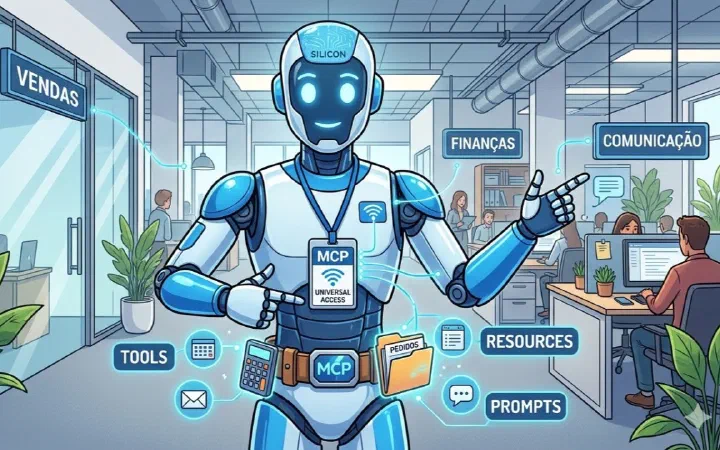
Model Context Protocol (MCP) = The Universal Score
MCP is the secret language that lets all the agents understand each other perfectly, like a musical score that syncs every note. More than simple communication, it lets agents share context, memory, and even “intuitions” about the data. When one agent spots an anomaly in sales, MCP makes sure that information reaches the other agents instantly, enabling correlated analyses that reveal insights impossible to detect in isolation.
The Magic in Practice
Real Scenario: A sales director, in the middle of a strategy meeting, quickly types in Teams: “I need to understand our quarterly sales to make an important decision right now”
Behind the scenes (it all happens in under 30 seconds):
- Copilot Studio receives the question and immediately recognizes it’s not a simple query: it’s an executive request that calls for multidimensional analysis. In milliseconds, it puts together an orchestration strategy.
- Sales Agent is called first and dives into the OneLake data, pulling not only raw revenue numbers but identifying patterns, regional trends, performance by product, and comparisons with previous periods.
- Finance Agent comes in at the same time, analyzing profit margins, operating costs, ROI by sales channel, and calculating projections based on current data.
- Marketing Agent correlates sales data with active campaigns, historical seasonality, consumer behavior, and competitor moves that may be influencing the results.
- Copilot Studio receives all these specialized analyses and, using MCP, identifies connections and insights that only emerge from combining the different perspectives, creating a cohesive executive narrative.
Result Delivered: A complete executive analysis with contextualized numbers, identification of opportunities and threats, relevant historical comparisons, and specific strategic recommendations, all formatted for immediate decision-making. The director has in hand not just data, but actionable intelligence.
Why Is This Revolutionary?
Before: The Era of Disconnected Soloists
Imagine trying to solve a complex business problem by consulting specialists who have never talked to each other. The sales analyst gave you cold numbers, finance only talked about margins, and the market specialist offered generic insights. You had to be the mental “conductor,” trying to connect fragmented and often contradictory information. It was like trying to put together a jigsaw puzzle where every piece came from a different box.
Now: The Symphony of Collective Intelligence
The digital orchestra completely changes this paradigm. The agents don’t just work together; they think together. When the sales agent identifies a drop in a particular product, the finance agent automatically analyzes the impact on margins, while the market agent checks for competitor moves. It’s emergent intelligence: the result of the collaboration is exponentially greater than the sum of the individual parts.
The Quantum Leap in Decision-Making
For the first time in business history, you have instant access to analyses that used to require entire teams working for days. More importantly: these analyses are contextually rich, considering multiple variables at once and identifying patterns that no single specialist could detect. It’s like having an advisory board of geniuses working 24/7 just for you.
The 3 Benefits That Change Everything
- Democratizing Executive Intelligence: It doesn’t matter whether you’re the CEO or a junior analyst; now anyone in the organization can ask complex questions and get C-level analyses. The digital orchestra removes the hierarchical barriers to accessing business intelligence. It’s like democratizing access to an elite advisory board, letting strategic insights flow through the whole organization and accelerating innovation at every level.
- Speed That Redefines Competitiveness: While your competitors are still scheduling meetings to discuss data, you’ve already made the decision and are executing. The digital orchestra compresses weeks of analysis into seconds of processing. More than efficiency, this represents a fundamental competitive advantage: the ability to respond to the market at the speed of thought, not at the speed of bureaucracy.
- Emergent Intelligence Insights: The real power of the orchestra isn’t in the individual agents but in the intelligence that emerges from their collaboration. Correlations impossible to detect manually, hidden patterns that only show up when multiple perspectives combine, and opportunities no single specialist could identify. It’s like having a magnifying glass that reveals invisible dimensions of your business.
How to Start Your Orchestra: A Practical Example
Let’s build a Sales Assistant that combines 3 specialized agents. Here’s the real step-by-step:
Step 1: Prepare the Data in Fabric
First, organize your data in OneLake:
-- Tabela de Vendas (Lakehouse)
CREATE TABLE vendas_historico (
          data_venda DATE
        , produto VARCHAR(100)
        , valor DECIMAL(10,2)
        , regiao VARCHAR(50)
        , vendedor VARCHAR(100) );

-- Tabela de Metas (Warehouse)
CREATE TABLE metas_vendas (
          mes INT
        , ano INT
        , meta_valor DECIMAL(12,2)
        , regiao VARCHAR(50) );
Step 2: Create the Fabric Data Agents
Agent 1: Sales Specialist
# No Fabric Data Science - Notebook
from databricks.agents import Agent

vendas_agent = Agent.create(
         name="VendasExpert",
  description="Especialista em análise de dados de vendas",
 data_sources=[ "workspace.lakehouse.vendas_historico",
                  "workspace.warehouse.metas_vendas" ],
 instructions=""" Você é um especialista em vendas. Analise:
                         - Performance vs metas
                         - Tendências por região
                         - Top produtos e vendedores
                         - Sempre inclua comparações históricas """
)
Agent 2: Financial Analyst
financeiro_agent = Agent.create(
             name="FinanceiroExpert",
      description="Especialista em análise financeira de vendas",
     data_sources=[ "workspace.lakehouse.vendas_historico",
                    "workspace.warehouse.custos_produtos" ],
     instructions=""" Você analisa aspectos financeiros:
                               - Margens de lucro por produto
                               - ROI por região
                               - Análise de rentabilidade
                               - Projeções financeiras """
)
Agent 3: Market Strategist
mercado_agent = Agent.create(
          name="MercadoExpert",
   description="Especialista em inteligência de mercado",
  data_sources=[ "workspace.lakehouse.vendas_historico",
                 "workspace.warehouse.dados_mercado" ],
  instructions=""" Você fornece contexto de mercado:
                            - Sazonalidade e tendências
                            - Comparação com concorrentes
                            - Oportunidades de crescimento
                            - Recomendações estratégicas """
)
Step 3: Set Up the Orchestration in Copilot Studio
3.1 - Create the Conductor Agent
In Copilot Studio, create a new agent:
Nome: "Assistente Vendas Executivo"
Descrição: "Coordena análises de vendas usando múltiplos especialistas"

Instruções do Sistema:
""" Você é um assistente executivo que coordena 3 especialistas:
- VendasExpert: dados de vendas e performance
- FinanceiroExpert: análise financeira e margens
- MercadoExpert: contexto de mercado e estratégia

Para cada pergunta:
1. Determine quais especialistas consultar
2. Faça perguntas específicas para cada um
3. Combine as respostas em uma análise executiva
4. Sempre inclua recomendações acionáveis """
3.2 - Configure the MCP Connections
{
  "connections": [
     { "name": "VendasExpert",
       "type": "fabric_data_agent",
       "endpoint": "https://fabric.microsoft.com/agents/vendas-expert"
     },
     { "name": "FinanceiroExpert",
       "type": "fabric_data_agent",
       "endpoint": "https://fabric.microsoft.com/agents/financeiro-expert"
     },
     { "name": "MercadoExpert",
       "type": "fabric_data_agent",
       "endpoint": "https://fabric.microsoft.com/agents/mercado-expert"
     }
  ]
}
Step 4: Test the Orchestra
Test Question: “How are our sales doing this quarter and what should we do?”
Orchestra Flow:
- Copilot Studio analyzes the question
- VendasExpert → “Q3 sales: R2.1M(target:R 2.1M (target: R2.1M(target:R 2M). 15% growth vs Q2”
- FinanceiroExpert → “Average margin 23%. Premium products with the best ROI”
- MercadoExpert → “Favorable seasonality through December. Competitor X losing market share”
- Copilot Studio combines everything
Final Answer
"✅ Performance Excelente: Superamos meta em 5% (R2.1MvsR 2.1M vs R
2.1MvsR
 2M)

📊 Destaques:
•Crescimento 15% vs trimestre anterior
•Margem saudável de 23%
•Produtos premium liderando rentabilidade

🎯 Recomendações:
•Intensificar foco em produtos premium
•Aproveitar sazonalidade até dezembro
•Expandir em regiões onde concorrente está perdendo espaço

📈 Projeção Q4: Com estratégia atual, potencial de R$ 2.4M"
Step 5: Deploy and Monitoring
# Publicar no Teams
copilot_studio.deploy_to_teams(
     agent_id="assistente-vendas-executivo",
     channels=["vendas", "diretoria"],
     permissions=["sales_team", "executives"]
)

# Configurar métricas
monitoring.setup_metrics([
                         "response_time",
                         "user_satisfaction",
                         "agent_collaboration_success",
                         "business_impact"
])
Result: In 2-3 weeks you have a working digital orchestra, turning simple questions into complete executive analyses.
The technology is in preview, but it already works. Pioneering companies are testing it and the results are impressive.
The Future Is Here
The era of isolated agents is over. Welcome to the era of intelligent orchestration, where AI isn’t just automation but genuine collaboration among digital specialists.
Is your company ready to have its own digital orchestra?
See you in the next article!
References
Fabric Data Agents + Microsoft Copilot Studio: A New Era of Multi-Agent Orchestration (Preview) - https://blog.fabric.microsoft.com/en-us/blog/fabric-data-agents-microsoft-copilot-studio-a-new-era-of-multi-agent-orchestration
Orchestrate agent behavior with generative AI - https://learn.microsoft.com/en-us/microsoft-copilot-studio/advanced-generative-actions